
How to Read Tarot Card Combinations: Putting Cards Together
Knowing what each card means is only half of reading. The other half is hearing how cards change each other when they sit side by side. This guide gives you practical ways to read pairs, patterns and whole spreads, ends with a five-card example and shows how to squeeze a crowded table into one clear sentence.
From single cards to a sentence
A single card is a word. Two cards are a phrase, and a spread is a paragraph with a point. Beginners often read a spread as a list, saying a sentence about each card in turn, and then wonder why it never adds up. The cards were drawn for the same question, so they are supposed to talk to each other.
The habit that changes everything is to look at the whole table before reading any card. Notice the colors, the weather, the faces and the crowds. A table full of storm skies and swords has a different mood from one full of gardens and cups, and that mood tells you how to hear each individual card. The Five of Pentacles amid sunlit cards reads as a bad patch that is passing. The same card among Swords reads as a hardship that is being made worse by thinking about it.
Then read the cards as a chain, joining them with small connecting words: because, but, so, until, even though. Those words are where the interpretation actually lives.
Flow and direction
Pictures have direction. The figures on the cards look somewhere, walk somewhere or turn their backs, and when you lay cards in a row those gazes make a kind of choreography. The Two of Cups has two people facing each other across a gap. The Five of Cups has a hunched figure with his back to two upright cups, staring down at the spilled ones. Put a card of comfort or company next to that figure and you can ask a useful question: is he looking toward it, or away from it?
Not every deck is drawn the same way, so do not treat gaze as a law. Treat it as a prompt. Ask whether the people in the cards face each other or look past one another, and whether the row of cards leads the eye forward or back. A line of figures who all look outward tells a different story from a line who all look at the same central card.
Direction also applies to the order in the spread. Past to present to future is a flow, and so is cause to effect or problem to advice. Once you know which kind of flow your layout uses, each card's role is clear.
Pairs and neighbors
The simplest combination is a pair. Take two adjacent cards and let one modify the other. A card that is noun-like, such as a court card or a person card, is shaped by a card that is verb-like or adjective-like.
Example: the Eight of Wands next to the Seven of Swords. Eight of Wands is things speeding up, news arriving fast. The Seven of Swords is caution, strategy and something not said. Together they might suggest that a quick development comes with a hidden detail, so slow down and check before you reply.
Another: the Nine of Pentacles beside the Four of Pentacles. The first is comfort that was earned, the second is clutching. Together they ask whether your security is something you enjoy or something you are guarding with white knuckles.
You can also read a pair as cause and effect. The Three of Swords followed by the Ten of Cups can say that a hurt is being healed by the warmth of the people around you. Reverse the order and it says something quite different: a happy home that is being pierced by a painful truth. Order matters, so say which way you are reading.
Suit dominance
Count the suits. If most of the cards belong to a single suit, that suit is telling you which part of life the question really lives in. A spread heavy with Cups is about feeling and relationships, even if you asked about a job. Heavy with Swords, it is about thought, communication and conflict. Heavy with Wands, it is about drive and action. Heavy with Pentacles, it is about money, work, the body and practical matters.
Also notice the missing suit. A spread with no Swords may mean that the thinking and talking has not happened yet. A spread with no Cups for a relationship question may mean that the feelings have not been named.
Do not over-read a dominant suit in a small spread. In three cards, two of one suit is a coincidence. In seven or ten, five of one suit is a theme. If you want to push further, ask what the dominant suit is trying to say about your relationship to that area. Is it a place of strength or of preoccupation?
Majors and minors
Count the Major Arcana too. The majors are the 22 big-theme cards, and the minors are the 56 everyday ones. A spread with a lot of majors tends to feel weighty: a turning point, a life lesson, something larger than the day-to-day. A spread without any majors tends to be about ordinary events and decisions, and it is not less important for that.
A single major among many minors is a spotlight. If you ask about a daily routine and get The Hermit, that card is probably the point of the reading. Read the minors as detail and the major as the heading.
Be careful about fear here. The Tower or Death landing among a lot of minors can look alarming. But a Major Arcana card in a small question is more often about the size of what the question means to you than about a catastrophe. Notice what the card names and what is nearby that offers a way through.
Repeated numbers and repeated courts
When the same number appears more than once, treat it as a theme. Two Fives point to conflict that has more than one source. Two Threes suggest that collaboration is the story, whether it is joyful or painful. Two Aces suggest a double beginning, which can be exciting and can be overwhelming.
When two or more court cards appear, there is often a social element: several people are involved, or several parts of you are pulling in different directions. If both are from the same suit, those people or parts share a style. If one is a Page and the other a King, ask who is learning and who is leading.
Repeated cards of the same rank across suits, such as a Knight of Wands and a Knight of Swords, can show a lot of momentum with not much looking at the road. The question to ask is where all this movement is going.
Reversed clusters
If you read reversals, count them as you count suits. One reversed card in a spread is a nuance on that card. Most of the spread reversed is usually a sign of a general slowdown, interiority or blockage, and the question becomes less about each card and more about what is holding the whole thing back.
Look at which upright cards remain. In a spread of mostly reversed cards, the upright ones are islands of clarity, and they often hold the way out. A reversed cluster also calls for gentleness: do not stack a verdict on each card. Say what the group seems to say, which might be “I am tired and everything is a bit stuck,” and then ask what rest, what help or what patience would loosen it.
A five-card worked example
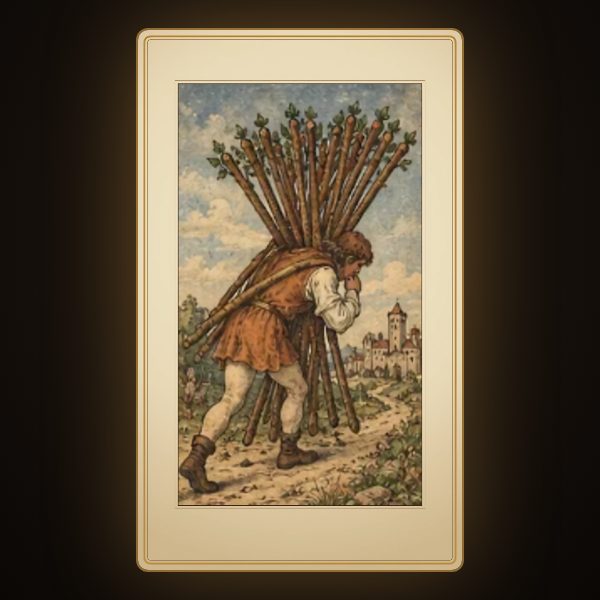
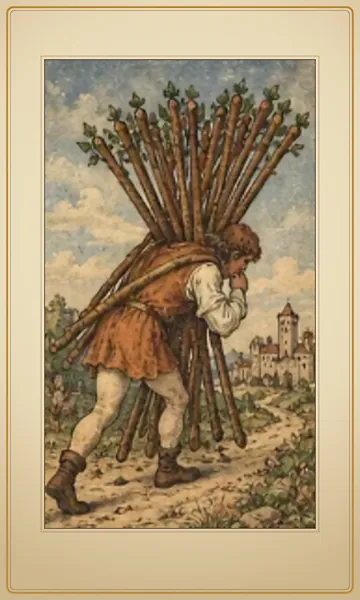
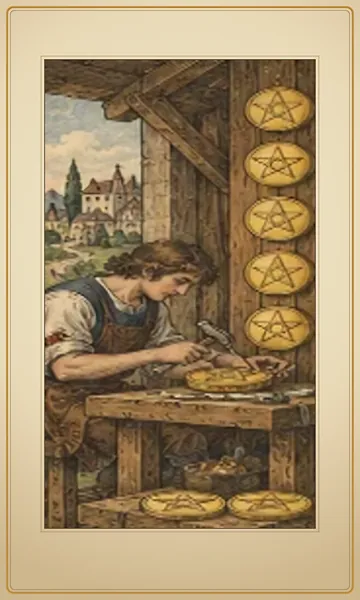
Question: “I am exhausted, and I have been asked to lead a new project at work. How should I approach this?” Five cards, laid left to right: the Ten of Wands, the Eight of Pentacles, the Page of Wands, the Four of Swords and Temperance.
Scan first. Two Wands, one Pentacles, one Swords, one Major. The tone is working and driven, with one quiet card in the middle of the row. Now chain them. The Ten of Wands says I am carrying too much, and the Eight of Pentacles says that I am carrying it because I am good at what I do, which has been noticed. The Page of Wands says that the new project excites me, but a Page is a beginner, so it will also be a learning curve. The Four of Swords says that what I need is rest, and Temperance says the sane path is moderate: not all in, not a flat refusal.
One sentence: I am overloaded because I am skilled, the new project tempts me, but I need rest first, so the wise move is to accept a measured version of it, or on a later date. That gives you a conversation to have with your manager.
Turning many cards into one clear sentence
When a table feels crowded, use this routine. First, note the mood of the whole spread in one word. Second, find the card that you keep looking at, which is often the heart of it. Third, find a contrast: a place where two cards disagree or pull in different directions. The contrast is almost always where your question actually lives. Fourth, find the advice, which might be one card or a pattern.
Then fill in the template: “This is a situation of ___ (mood). The heart of it is ___ (key card), but ___ (contrast). The next step is ___ (advice).” If your sentence has more than two commas, simplify it.
A good test is to say your sentence to a friend and see if they can repeat it back. If they can, you have read the spread. If not, return to the cards and cut back to what you really saw.
Cards in this guide
 Ten of Wands
 Eight of Pentacles
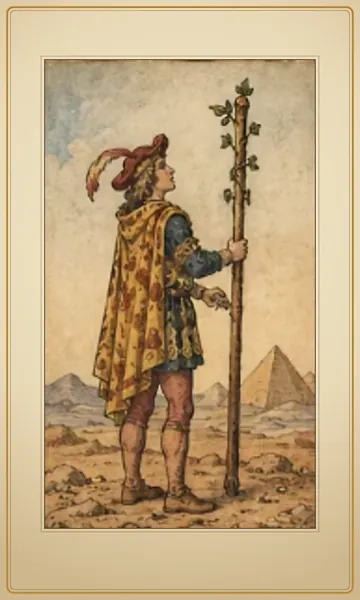 Page of Wands
 Four of Swords
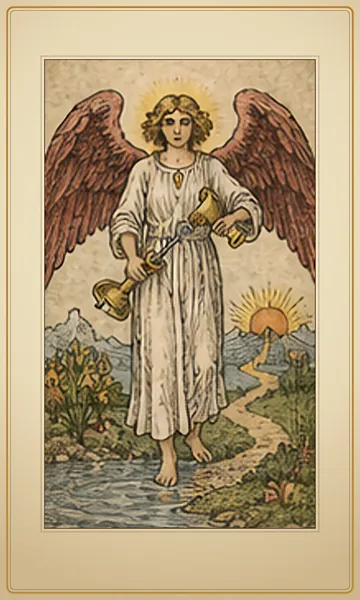 Temperance
 Three of Swords
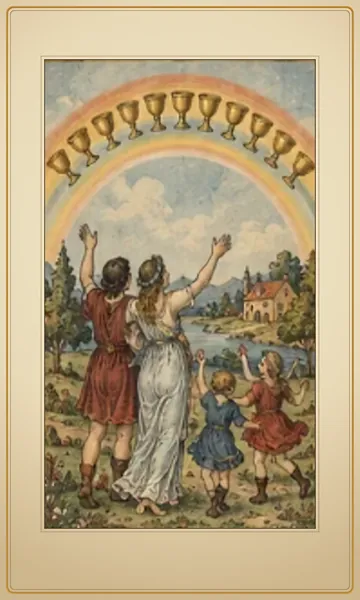 Ten of Cups
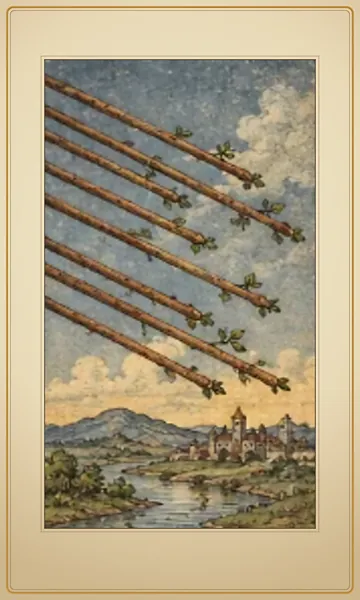 Eight of Wands
Questions people ask
How do I read two tarot cards together?
Read the first card, then ask how the second one changes it. Use connecting words such as but, so, because and until to link them. Say which direction you are reading in, since a hurt followed by comfort is a different story from comfort followed by a hurt.
What does it mean if one suit dominates a spread?
It suggests which area of life the question truly lives in: Cups for feeling, Swords for thought and conflict, Wands for drive and Pentacles for work and money. In small spreads it may be a coincidence, so give it more weight when the spread is large.
Does a spread with many Major Arcana cards mean something big is coming?
It often feels weightier because the majors speak in big themes. That can mean the matter is significant to you, not that an event is on its way. Treat it as a cue to slow down and read carefully.
How do I stop a big spread from feeling overwhelming?
Scan the whole table for mood, find the card that draws your eye, spot one contrast and look for one piece of advice. Then say it in one sentence. If it will not fit in a sentence, read fewer cards at a time.