


Tarot Spreads for Beginners: Six Simple Layouts to Try
Once the three-card spread feels easy and the Celtic Cross feels like a lot, there is a wide middle ground. These six small layouts each do one job well: a daily prompt, a choice between two paths, a relationship check-in, a week, a month, and a clear-out. For each you get when to use it, what every position means and a short worked example.
How to choose a spread
A spread is only a set of questions laid out on a table, so the best one is the one that fits what you are actually asking. Use one card when you want a prompt, three or four when you want a story, five when you are weighing something, and seven only when you have the patience to keep seven pictures in your head at once.
Before you shuffle, say each position's name out loud. “This card is what I bring” is a different question from “this card is what I avoid,” and the same Five of Swords will answer them differently. Writing the positions down on a scrap of paper and setting it beside the cards is a good habit, since it stops the meanings from sliding around as you read.
The six layouts below are deliberately small. None needs more than seven cards, and all of them end with something you can do, which is the test of a layout worth keeping.
The one-card daily draw
Use it every morning, or whenever you want a small point of focus. The single position is: what is most worth noticing today? Shuffle, draw one card and look at the picture for a full minute before you read a word about it. Then write one sentence on what you see and one on where it might show up in your day.
Say you draw the Four of Cups. A figure sits under a tree, ignoring the cup being offered from a cloud. You might write: “I am in a flat mood and I tend to wave things away.” Your task for the day becomes small and concrete: accept one invitation, taste what is in front of you, notice one thing that is being offered.
In the evening, look at the card again and ask if it showed up in any way. Keep the question honest. If it did not, that tells you something too, and you are not obliged to stretch a meaning to make it fit.
The two-options decision spread
Use this when you are torn between two real paths and each pulls for good reasons. Lay out five cards. Place one card at the top: what I value most in this choice. Under it, make two columns. In the left column, put two cards for Option A: its gift and its cost. In the right column, do the same for Option B.
The top card matters more than it looks, because decisions usually go wrong when we compare options against a value we have not named. Read it first, then read each column against it.
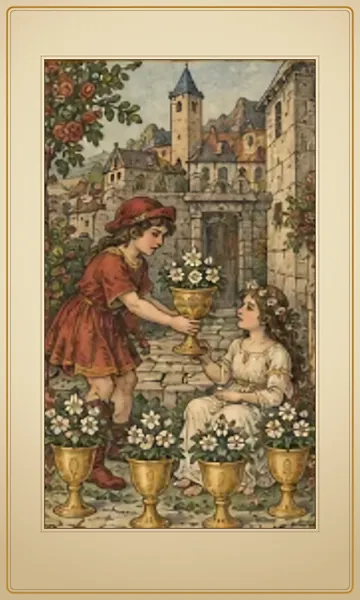
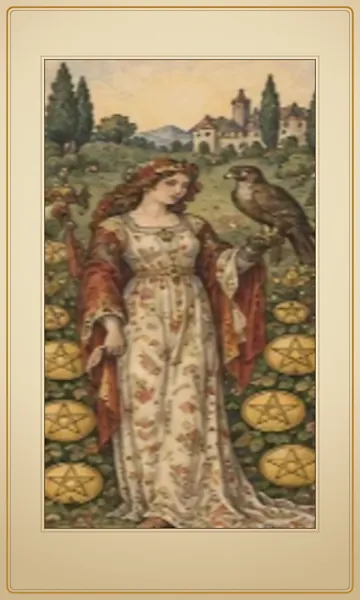
Example: someone choosing between taking a job in another city and staying put. The top card is the Four of Wands, so what they value is belonging and a place that feels like home. Moving has the Ace of Wands as its gift, fresh energy, and the Five of Cups as its cost, grief for what would be left behind. Staying has the Nine of Pentacles as its gift, comfortable independence, and the Four of Cups as its cost, a creeping flatness. The reading does not choose. It reframes the question: can belonging be built in a new city, or can the energy of the Ace be found at home?
The relationship spread: you, them, the bond
This works for a partner, a friend, a parent or a colleague. Use three cards, or add a fourth. Card one is you: what you bring to this relationship right now. Card two is them, with a firm limit: it shows how their part looks from where you are sitting, not what is going on inside their head. Card three is the bond: the thing that lives between you and belongs to neither alone. An optional fourth card is what would help.
The honest version of card two matters. You cannot know another person's feelings from a card, and a reading that claims to is entertainment at best and a source of misunderstandings at worst. Treat that card as your perception, and the thing you could check by asking them.
Example: a friendship that has drifted. You draw the Six of Cups, the Eight of Wands and the Four of Cups. You are holding on to the way things used to be. They appear, from your side, to be moving fast and busy with their own life. The bond has gone flat, with offers not taken up. The fourth card, if you add one, might be the Page of Cups: a small, sincere message. No big talk required.
The weekly spread
Use it on Sunday evening or Monday morning. The full version is seven cards, one for each day, but a lighter three-card version works well for busy people: the start of the week, the middle and the weekend.
Treat the cards as weather, not as a forecast. You are not predicting that Wednesday will bring a fight. You are asking what quality you might meet and how you want to dress for it. Place the cards face up in a row and read them as a short story with a beginning, a turn and an ending.
Example, three-card version: the Seven of Pentacles at the start, the Five of Wands in the middle and the Four of Swords at the weekend. The week opens with a patient look at something you have been working on. Midweek has friction, perhaps a meeting where everyone talks at once. The weekend asks for real rest. The sensible move is to hold your own opinion lightly on Wednesday and protect Saturday morning.
The new moon or monthly intention spread
Use this at the start of a month, or on a new moon if you like marking the calendar that way. Draw four cards. One is the seed: what I want to grow. Two is what stands in the way. Three is what supports me. Four is the first small step.
The spread works because it builds an intention out of a feeling you probably already have. Keep the seed modest. “Sleep better” is a better seed than “fix my life.”
Example: you want to rest better. The seed is the Four of Swords, restoration. What stands in the way is the Nine of Swords, the late-night worrying mind. What supports you is Temperance, a steady, moderate rhythm. The first step is the Page of Pentacles, a small practical start such as a fixed bedtime for one week. At month's end or the full moon, lay the cards out again from memory and note what changed. If worry about sleep or mood is serious or long-lasting, speak to a doctor rather than a deck.
The release and invite spread
Use it when life feels crowded, at a change of season or after something has ended. It has four cards in two pairs. Card one is what I am ready to release. Card two is what it gave me, because anything we hold on to is doing something for us. Card three is what I would like to invite. Card four is how I make room.
Example: someone who is exhausted from always being the one who does everything. Release: the Ten of Wands, the overloaded load. What it gave me: the Six of Wands, recognition, the pleasure of being the dependable one. Invite: the Three of Cups, ordinary company and shared effort. Making room: Strength, which here means saying no gently, without drama. The reading names a real trade: they will give up some applause in return for some lightness.
Take a moment with card two. People skip it and then cannot work out why a habit keeps returning. If you understand what it gave you, you can find another way to meet the same need.
Making your own, and keeping a record
Once you have used these a few times, you will start to bend them, and you should. Add a clarifier card, drop a position that never helps, or swap a column. A good test is whether you can summarize the whole spread in one sentence. If you cannot, there are probably too many cards.
Keep a simple record: the date, the spread, the cards and your one-sentence reading. Come back to it in a month. You will see which layouts produce useful readings for you and which feel flat, and that personal data is worth more than any rule in a book.
Cards in this guide
 Four of Cups
 Six of Cups
 Ten of Wands
 Four of Swords
 Nine of Swords
 Eight of Wands
 Nine of Pentacles
 Ace of Wands
Questions people ask
How many cards should a tarot spread have?
As few as the question needs. One card gives a prompt, three give a story, five let you weigh a choice. Beyond seven, most people lose the thread, so only go bigger when you have a clear reason and time to read slowly.
Can I make up my own tarot spread?
Yes. A spread is just a list of questions with a card for each, so anything that gives you clear positions will work. Start from a layout you know, change one position, and see whether the reading becomes more useful.
Do the positions in a spread really matter?
They matter because they tell you which question each card is answering. The same card reads differently as “what I bring” and as “what stands in the way.” Name the positions before you draw and the reading will stay focused.
How often should I do a spread?
Daily draws and weekly spreads suit a regular habit, while larger layouts are best saved for moments when you have a real question. Asking the same thing over and over rarely helps. If you want to repeat a spread, wait until something has changed.